

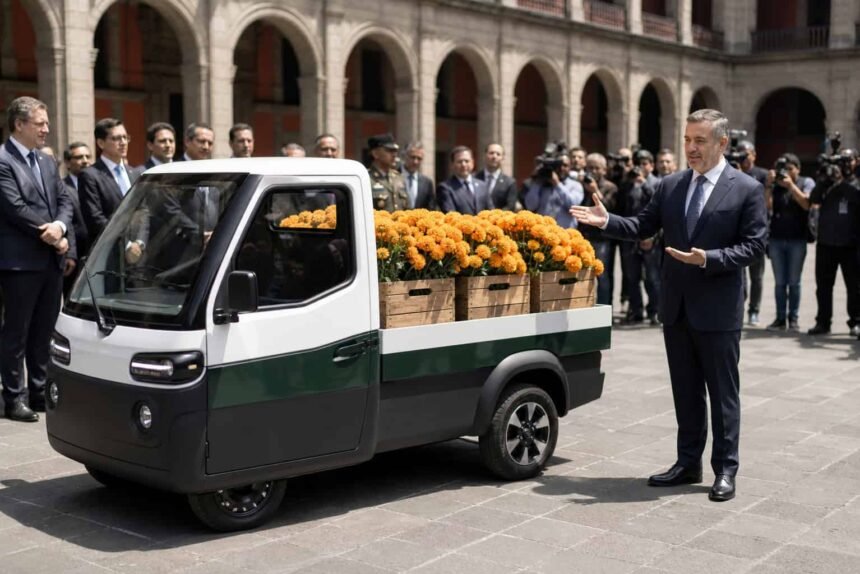
In a significant advancement for Mexico’s industrial landscape, the federal government has introduced the prototype of the Olinia Carga, a uniquely designed electric vehicle aimed at enhancing local transportation. Launched at the National Palace, this innovative vehicle seeks to improve daily logistics by providing an eco-friendly option for moving small items efficiently, benefiting countless residents who rely on such transport.
The Olinia Carga is part of the government’s “mini-electromobility” initiative and aims to disrupt the micro-logistics sector. With its practical design, this low-cost vehicle is built to transport lightweight deliveries that would typically require two people or a sturdy wheelbarrow. Project director Roberto Capuano emphasized that the design reflects the everyday needs of our communities, bridging the gap between traditional transportation methods and modern requirements.
Capable of a maximum range of 120 kilometers and able to carry up to 650 kilograms when correctly loaded, the Olinia Carga is engineered for urban environments. Its unique low trunk design, which replaces the traditional engine, allows for versatile storage, making it ideal for transporting items like tables or umbrellas without any fuel consumption.
Engineers involved in the project noted that this vehicle is not only functional but also environmentally friendly, as it can idle at local stores without emitting greenhouse gases. Capuano highlighted the goal of custom-engineering electric solutions that cater specifically to the needs of our neighborhoods, implying that future manufacturing partnerships will focus on maximizing the vehicle’s compact design, allowing it to navigate congested areas smoothly.
Projected to launch in late 2027 at a price of around 150,000 pesos, the Olinia Carga is anticipated to fill a vital niche in local transport services, particularly for goods like fresh produce across short distances. As the government continues to push for sustainable innovations, initiatives such as the Olinia Carga are expected to play a crucial role in promoting both local business efficiency and environmental sustainability in everyday life.