

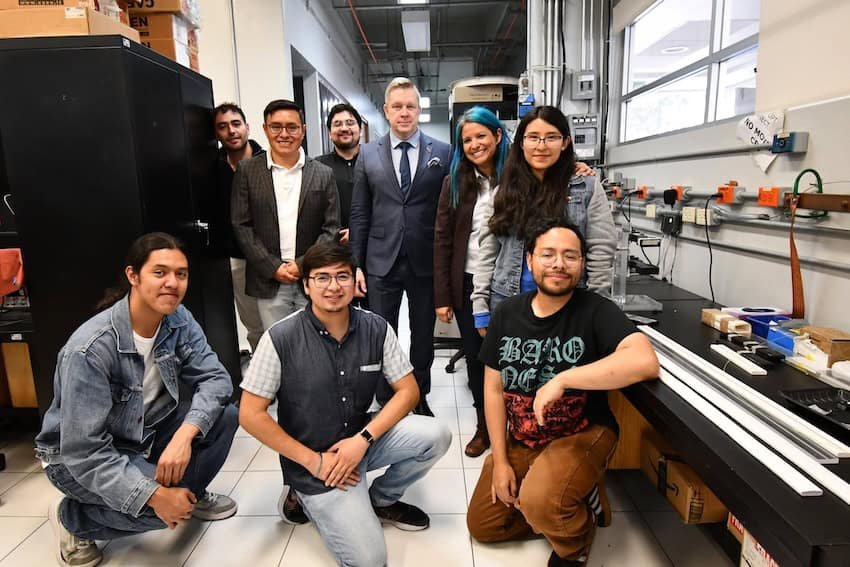
A significant achievement for Mexico’s scientific community has emerged as Antonio Ortiz Velásquez, a respected researcher from the National Autonomous University of Mexico (UNAM), has been appointed to lead the development of a cutting-edge particle detector. This project, known as the Muon Identifier Detector (MID), is destined for the European Organization for Nuclear Research (CERN), where it will play a vital role in unveiling the mysteries of the universe, particularly the conditions that followed the Big Bang.
The MID is planned to be an integral part of ALICE 3, a future iteration of one of CERN’s primary experimental apparatuses at the Large Hadron Collider, located along the French-Swiss border. Should the project advance as intended, it would grant Mexican institutions a crucial responsibility for a central subsystem of this monumental experiment, reinforcing Mexico’s presence in the global scientific arena.
This innovative device, designed to track muons—particles that can pass through various materials—aims to replicate and analyze transient states of matter, mirroring the universe’s early moments. While the project is still in its preliminary stages, the timeline aims for completion of construction in Mexico by 2028, with operations targeted for 2036.
Despite its promising foundation, the project requires significant endeavors ahead. The team must secure funding, finalize the design and construction work, and pass necessary technical reviews to ensure a successful installation at CERN. Ortiz, the first Mexican scientist chosen to direct such a strategic ALICE 3 subsystem, leads a collaborative team that includes researchers from various institutions across Mexico and international partners from the United States, Hungary, the Czech Republic, and Pakistan.
Mexico has an established history working with ALICE, contributing to previous detector systems and data analyses. The MID project represents a leap forward, demonstrating the country’s capabilities and commitments to advancing scientific knowledge on both national and international levels. The excitement surrounding this initiative fosters hope for increased educational and research opportunities, potentially benefiting countless students and aspiring scientists within the nation.