

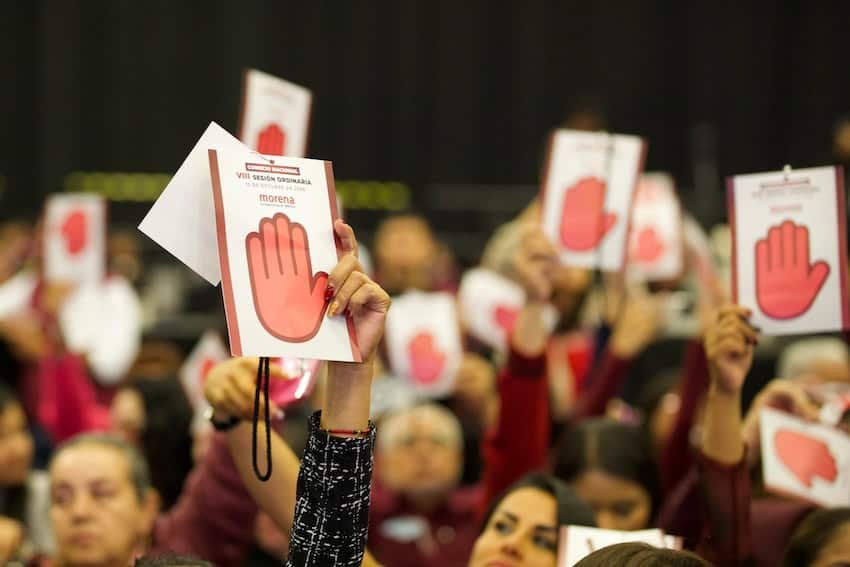
In June 2027, Mexico will hold its midterm elections, an event that could significantly influence your daily life. Currently, the ruling party, Morena, leads in national voter preference with 46%, as reported by a recent poll from El Financiero. This dominance suggests a strong likelihood that government policies will continue in a manner that reflects Morena’s agenda, impacting areas such as healthcare and education.
Distantly trailing behind, the National Action Party (PAN) stands at just 8%. A notable aspect of the poll is that 31% of respondents indicated “no preference,” hinting at potential shifts in voter sentiment as the election date approaches. Following the PAN, the Institutional Revolutionary Party (PRI) garnered 6%, while Citizens’ Movement (MC) received 5%. The Green Party and Labor Party, allies of Morena, obtained 2% and 1%, respectively. Newly formed parties PAZ and Somos, still in their nascent stages, each captured less than 1%.
In gauging public opinion beyond just voting intention, Morena holds the highest favorable rating at 55%. Its partners, the PV and PT, follow with 31% and 29%. The PAN, in stark contrast, earned a positive opinion from only 26% of eligible voters, while the PRI received just 21%. Alarmingly, these two historic parties face significant disapproval, with negative ratings reaching 64% and 70%, respectively.
When examining the 17 governorships up for contest, early polling data suggests that while Morena maintains a lead, conditions vary by region. In states like Baja California, Guerrero, and Quintana Roo, candidates from Morena or its allied bloc show strong polling numbers, often leading by substantial margins. However, in places like Sinaloa and Michoacán, the lead is less assured, with some polls even showing new candidates in contention.
Conversely, the northern states such as Baja California Sur and Chihuahua present a competitive landscape, with the PAN holding the advantage in early polling. In the Bajío region, states like Querétaro and Aguascalientes lean towards the PAN, while a split in political alliances has emerged in San Luis Potosí, complicating the landscape for Morena.
As the midterm elections approach, these dynamics will be crucial for citizens, emphasizing the importance of engagement and participation in shaping the future direction of local and national policies.