

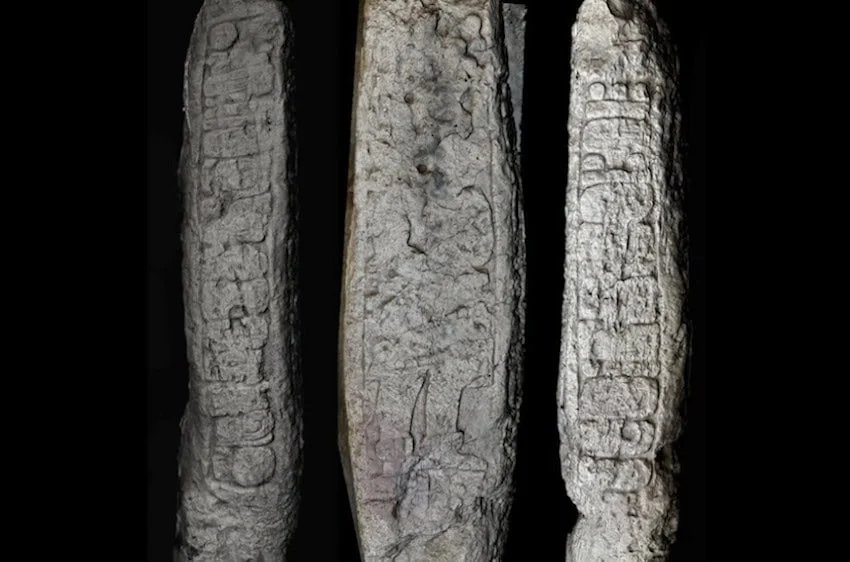
A groundbreaking study has revealed that a stela from the ancient Maya civilization, discovered in Campeche, contains the oldest documented Long Count inscription in the Maya Lowlands. This finding not only reshapes our understanding of Maya history but also emphasizes the significance of these ancient cultures in Mexico’s heritage.
The new insights indicate that the Maya developed complex writing systems and established dynastic lineages much earlier than previously believed. Known as Stela 46, this nearly three-meter-tall limestone monument features a carving of a Maya ruler, adorned with a feathered headdress and holding a jaguar’s head, which carries deep symbolic meaning.
This stela dates back to August 31, 180 CE, making it the earliest Long Count date recorded in the region, predating the previous record by 112 years. Scholars now know that King Ajaw K’al Ubaah ascended to power in 131 CE and, nearly five decades later, marked significant events in his reign by inscribing them on this monumental stone.
The Maya Long Count is a unique calendar system that tracks absolute time, allowing for the documentation of historical events. Unlike modern cyclical calendars, it identifies each day uniquely, drawing from a creation date of August 11, 3114 BCE. This stela connects the calendar to royal succession, illustrating how the Maya utilized time as a political tool.
Research using high-resolution 3D scanning technology allowed scholars to analyze the previously eroded inscriptions, revealing crucial information about early power structures in the Maya Lowlands. The analysis shows that by the early centuries CE, cities in this region had sophisticated governance systems capable of supporting the construction of stelae and the creation of intricate hieroglyphic texts.
Stela 46 was unearthed decades ago at the El Palmar archaeological site, an area rich in Maya history. To protect it from looters, the stela was stored away in 1985. Over the years, researchers struggled to read its inscriptions until modern scanning techniques provided a breakthrough, allowing them to illuminate otherwise hidden details. These findings were recently published in the academic journal “Ancient Mesoamerica.”
Today, after careful restoration, Stela 46 is permanently displayed at the Museo de Arquitectura Maya in Campeche, inviting visitors to explore its historical relevance and the rich culture it represents. This discovery not only enhances the understanding of the ancient Maya but also fosters a deeper connection to Mexico’s cultural roots.