

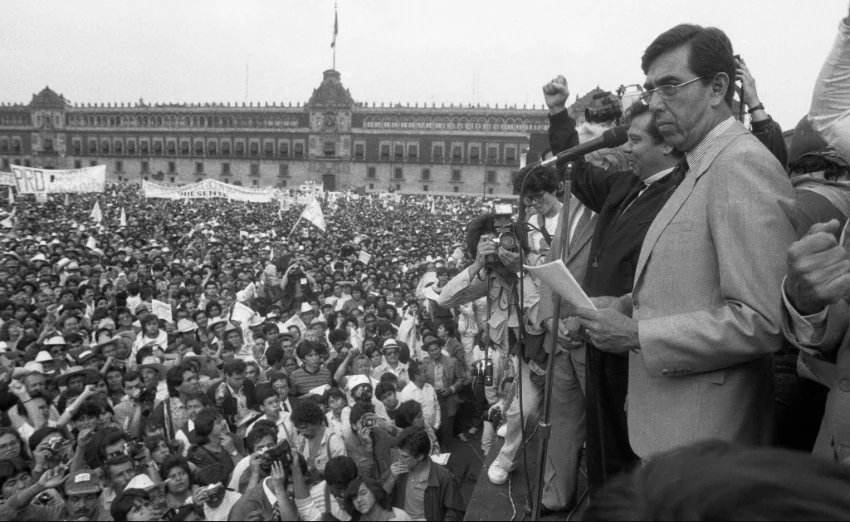
Cuauhtémoc Cárdenas Solórzano, a pivotal figure in Mexico’s democratic evolution and a three-time presidential candidate, passed away in Mexico City at the age of 92. His death marks the loss of a leader who profoundly influenced the nation’s political landscape and sparked the quest for democratic elections, impacting the lives of millions.
Cárdenas died at Ángeles Metropolitano Hospital, though the exact cause remains unspecified. President Claudia Sheinbaum and former President Andrés Manuel López Obrador shared their condolences publicly, describing Cárdenas as a man of deep principles who played a significant role in transforming Mexico’s political life. Both leaders acknowledged his legacy as a precursor to modern democracy.
Throughout his political career, Cárdenas was instrumental in dismantling the long-standing dominance of the Institutional Revolutionary Party (PRI), serving first as a member before leaving in 1987. He ran as the candidate for the National Democratic Front in the contentious 1988 presidential election, widely believed to have been won by Cárdenas despite results favoring the PRI’s Carlos Salinas de Gortari. His campaign and subsequent actions galvanized public sentiment and led to pivotal changes in Mexico’s political fabric.
Born in Mexico City on May 1, 1934, Cárdenas was shaped by his father’s significant legacy, including the nationalization of the oil industry. His formative years were spent in the presidential residence, Los Pinos, where he gained insights into governance. He went on to study civil engineering at the National Autonomous University of Mexico (UNAM) before embarking on a political career.
Cárdenas served as governor of Michoacán and a federal senator, where he grew increasingly critical of the federal government’s neoliberal policies. He co-founded the Democratic Revolution Party (PRD) in 1989, establishing a viable leftist alternative to the PRI. Cárdenas contested elections in 1994 and 2000, advocating for economic nationalism and voters’ rights.
Despite not winning the presidency, his influence paved the way for future political movements and celebrated the emergence of competitive democracy in Mexico. His commitment to national sovereignty and social justice defined his ideology, as he addressed issues affecting everyday citizens from energy reforms to educational access.
In his later years, he remained vocal about national challenges, urging action against organized crime and advocating for better public resources. Cárdenas’s legacy also includes recognition with the Belisario Domínguez Medal, acknowledging his contributions to political discourse in Mexico.
He leaves behind three children and multiple grandchildren, with his family continuing to engage in public service. His passing ignites reflections on the significant strides made in Mexican democracy, as citizens remember his dedication to the nation’s future.